
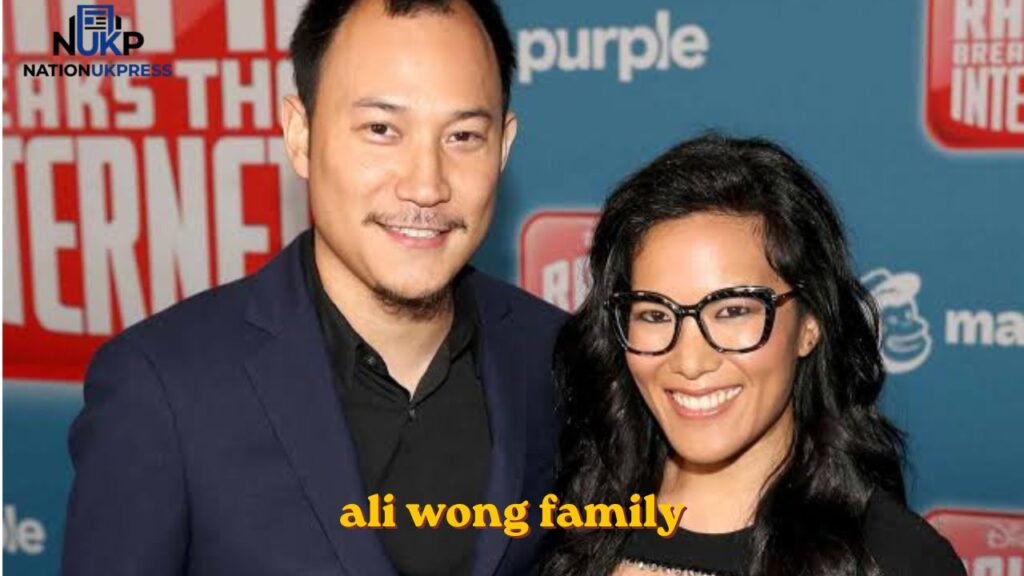

When people search for Ali Wong family, they often expect a simple list of her parents, siblings, children and former husband. The fuller story is much more interesting. Wong’s comedy has been shaped by several generations of immigrant experience, a large age gap between siblings, complicated cultural identity and, later, the realities of raising children while building a demanding entertainment career.
Ali Wong was born Alexandra Dawn Wong on April 19, 1982, in San Francisco’s Pacific Heights neighborhood. She is the youngest of four children. Her father, Adolphus Wong, was Chinese American and worked as an anesthesiologist, while her mother, Tam “Tammy” Wong, was born in Vietnam and later moved to the United States.
Today, Wong is also a mother of two daughters, Mari and Nikki, whom she shares with her former husband, Justin Hakuta. Their family story is notable not because it fits a conventional celebrity-family template, but because Wong has repeatedly used family history, motherhood and cultural expectations as material for understanding her own life.
Who Is in Ali Wong’s Family?
At the simplest level, Ali Wong’s immediate family includes:
- Her late father, Adolphus Wong
- Her mother, Tam “Tammy” Wong
- Three older siblings
- Her two daughters, Mari and Nikki
- Her former husband and co-parent, Justin Hakuta
Wong is the youngest of four children, and her siblings are substantially older. One especially useful detail comes from a 2016 New Yorker profile, which described her two sisters as stay-at-home mothers and her brother as an acupuncturist.
That age difference matters when understanding Wong’s childhood. She was not growing up in a household where everyone was at the same life stage. By the time she was a child, her older siblings were already much further along in adulthood.
Ali Wong’s Parents Were From Different Asian American Backgrounds
Wong’s family background combines Chinese American and Vietnamese American histories.
Her father, Adolphus Wong, was born in San Francisco to Chinese immigrant parents. He later became an anesthesiologist and worked for Kaiser Permanente for approximately 30 years. Wong has spoken openly about how modest her father’s childhood was and how much education represented an investment in his future.
Her mother, Tam Wong, was born in Huế, Vietnam. She moved to the United States as a young woman and worked as a social worker. Sources describing Wong’s family history place her mother’s move to the United States in 1960, when she was around 20.
This distinction is important because “Asian American” is sometimes treated as one single cultural category. Wong’s childhood was more specific than that: her father’s family was Chinese American, while her mother’s roots were Vietnamese.
What Happened to Ali Wong’s Father?
Ali Wong’s father, Adolphus Wong, died in 2011. His death became an important part of how Wong later thought about family, memory and adulthood.
Wong has explained that her father had an enormous influence on her personality and sense of humor. He was academically successful, but she also remembers him as unconventional and irreverent. In interviews, she has described his ability to make inappropriate jokes and ignore social expectations as part of what influenced her own comedic instincts.
There is another layer to their relationship that is easy to miss.
Wong has said that her father left her a letter before he died. Years later, she described wishing that she had known more about who he was before she was born. That feeling helped motivate some of the family storytelling in her book Dear Girls.
That is one reason her family material can feel more personal than ordinary celebrity anecdotes. Her jokes about relatives are often connected to a larger question: What do children really know about their parents as people?
Her Father’s Childhood Was Very Different From Hers
One of the most revealing parts of Wong’s family history is the difference between her father’s childhood and the environment he eventually created for his children.
Wong has recalled that her father grew up in a one-bedroom Chinatown apartment without running water. He shared a bed with his mother and two sisters, while his father reportedly slept on newspapers on the floor. His parents could afford to send only one child to college, and that investment went toward him.
He eventually became a doctor.
For Wong, this created a striking generational contrast. Her father had experienced scarcity directly, while his children grew up with significantly more stability. That kind of transition is common in immigrant families, but Wong’s comedy makes the emotional contradictions visible: gratitude, pressure, ambition, embarrassment and love can all exist at the same time.
Is Ali Wong’s Mother Still Part of Her Life?
Ali Wong’s mother, Tam “Tammy” Wong, has remained an important figure in her public family story.
Unlike her husband, Tammy has continued to appear in accounts of Wong’s life and has occasionally been mentioned in Wong’s speeches and interviews. Wong has also talked about her mother’s reaction to her decision to pursue stand-up comedy.
That reaction is worth understanding in context. Wong did not choose the most predictable professional route after graduating from UCLA. Her parents had established conventional professional careers, while she chose the uncertain world of comedy.
The tension between parental expectations and creative ambition became part of Wong’s story.
In 2024, Wong publicly thanked her mother while accepting a major award, emphasizing how much her family had contributed to the life she eventually built.
Because information about Tammy’s private life is limited, it is better not to assume details about her current circumstances beyond what Wong and reliable reporting have publicly established.
How Many Siblings Does Ali Wong Have?
Ali Wong has three older siblings, making her the youngest of four children.
Public profiles have identified an older brother and two older sisters. Her siblings have generally maintained much lower public profiles than Wong, which explains why considerably less information is available about them.
The New Yorker reported that Wong’s two sisters were stay-at-home mothers and that her brother worked as an acupuncturist.
The important point is that Wong did not grow up as an only child or in a celebrity household. She came from a relatively large family in which her siblings were much older and already had their own lives.
Why Being the Youngest Matters
Being the youngest can affect family dynamics in ways that are difficult to see from a biography.
Wong has described herself as a keen observer when discussing childhood. In an interview with The Guardian, she recalled listening carefully and remembering specific details about what people said and how they said them.
That is particularly relevant to a comedian.
Stand-up depends heavily on observation: tone, timing, contradiction, awkwardness and small behavioral details. Growing up around adults who were significantly older may have given Wong an unusual amount of material to observe.
This is one of the less obvious connections between her family structure and her professional voice.
Who Are Ali Wong’s Children?
Ali Wong has two daughters, Mari and Nikki, with Justin Hakuta.
Mari was born in 2015, and Nikki was born in 2017. Wong has spoken extensively about motherhood, both in her stand-up and in her writing.
Her daughters became part of a very different phase of her career. Wong filmed Baby Cobra while heavily pregnant with Mari, and she later filmed Hard Knock Wife while pregnant with Nikki. Those performances became closely associated with her willingness to discuss pregnancy, childbirth, breastfeeding and the pressures of working motherhood without presenting them as polished or glamorous experiences.
Why Her Daughters Are Kept Relatively Private
Although Wong talks openly about being a mother, she has generally been much more careful about turning her daughters into public celebrities.
That distinction is important.
There is a difference between saying, “I am a mother and this is how motherhood affects me,” and making children’s private lives part of an entertainment brand. Wong has largely kept the focus on her own experience of parenting rather than providing extensive personal details about her daughters.
That approach also explains why many online pages contain more speculation about Mari and Nikki than genuinely useful information.
Ali Wong and Justin Hakuta’s Family
Wong met Justin Hakuta in 2010 at the wedding of mutual friends. Hakuta is the son of television personality and inventor Ken Hakuta and has a background in business and technology. The couple married in 2014 and had two daughters.
They announced their separation in April 2022 after eight years of marriage. Wong filed for divorce in December 2023, and the divorce was finalized in 2024.
But the end of their marriage did not mean the end of their family relationship.
Wong has repeatedly described Hakuta as a close friend and emphasized the importance of maintaining a cooperative relationship because they are raising two children together. During her 2024 Golden Globes acceptance speech for Beef, she specifically thanked him for his support and for helping make it possible for her to be a working mother.
Their Co-Parenting Story Is More Important Than the Divorce
Celebrity divorce coverage often focuses on the breakup itself. In Wong’s case, the more useful family story is what happened afterward.
Wong has explained that remaining connected to an ex-partner can make sense when children are involved. In a 2024 interview, she discussed the importance of maintaining a relationship with Hakuta rather than treating the end of the marriage as the end of their family connection.
For parents facing separation, that is a practical distinction worth noticing:
- A marriage can end.
- Parenting responsibilities continue.
- Children still need stability.
- Cooperation can sometimes be more valuable than maintaining distance.
Wong’s public comments suggest that she has deliberately tried to separate the romantic relationship from the parenting relationship.
How Ali Wong’s Family Influenced Her Comedy
Family is not simply a topic Wong occasionally mentions. It is one of the foundations of her storytelling style.
Her comedy draws on:
- Immigrant family expectations
- Asian American identity
- Motherhood
- Marriage and divorce
- Generational differences
- Money and work
- Cultural misunderstandings
- The awkwardness of family relationships
Her 2019 book, Dear Girls: Intimate Tales, Untold Secrets & Advice for Living Your Best Life, is especially revealing because it is structured around letters to her daughters. Wong’s official biography describes the book as autobiographical and centered on advice and personal stories addressed to her children.
This creates an interesting reversal.
Wong learned about her own parents partly through memories and stories after becoming an adult. She then deliberately created a record of her own experiences for her daughters.
In that sense, Dear Girls is not simply a celebrity memoir. It is also an attempt to preserve family history for the next generation.
Ali Wong’s Cultural Heritage Explained
Ali Wong is often described as Vietnamese American and Chinese American, but her identity cannot be reduced to a single label.
Her father came from a Chinese American family in San Francisco. Her mother was born in Vietnam. Wong has discussed how her childhood home was heavily influenced by Chinese American culture, even though she is half Vietnamese.
That distinction produced an unusual experience: having Vietnamese ancestry without necessarily feeling that she had grown up deeply immersed in Vietnamese culture.
She later studied Asian American Studies at UCLA and spent time in Vietnam, including through a Fulbright-related program. Her experience abroad also made her more conscious of the gap between ancestry and lived cultural identity.
This is one of the most useful ways to understand Wong’s family story: heritage and culture are related, but they are not always identical.
Three Less-Obvious Insights About Ali Wong’s Family
1. Her family story is really about generational mobility
Wong’s father’s childhood involved severe financial limitations, while his daughter eventually became a highly successful entertainer. The distance between those two realities helps explain why education, work ethic and financial security appear repeatedly in Wong’s stories.
2. Her father’s personality influenced more than her values
It is easy to focus on Adolphus Wong’s professional achievement. But Wong has also described his irreverence and refusal to care about social conventions as influential. That may help explain why her comedy so often breaks deliberately uncomfortable social rules.
3. Motherhood changed how she viewed family time
Wong has spoken about becoming more intentional about family after losing her father. Earlier in her career, work commitments could take priority over family occasions; later, she became more conscious of making room for family and even planning professional activities around her children’s schedules.
That change is easy to overlook when reading a standard celebrity biography, but it helps connect her personal history with the way she approaches motherhood and work today.
FAQ
Who are Ali Wong’s parents?
Ali Wong’s parents were Adolphus Wong and Tam “Tammy” Wong. Her father was Chinese American and worked as an anesthesiologist, while her mother was born in Vietnam and worked as a social worker. Adolphus died in 2011, while Tammy has remained a recurring presence in Wong’s public family stories.
How many children does Ali Wong have?
Ali Wong has two daughters, Mari and Nikki, with her former husband Justin Hakuta. Mari was born in 2015 and Nikki in 2017. Wong has discussed motherhood extensively while generally protecting her children’s private lives.
Does Ali Wong have siblings?
Yes. Wong is the youngest of four children and has three older siblings. Public reporting has described her family as including two older sisters and an older brother, although her siblings have generally stayed out of the spotlight.
What is Ali Wong’s ethnic background?
Ali Wong has Chinese American heritage through her father and Vietnamese heritage through her mother. She has spoken about growing up in a household that was strongly influenced by Chinese American culture while also having Vietnamese ancestry.
Who is the father of Ali Wong’s children?
The father of Ali Wong’s two daughters is Justin Hakuta. Wong and Hakuta married in 2014, separated in 2022 and finalized their divorce in 2024. Despite the divorce, Wong has publicly described him as a close friend and emphasized their continuing role as co-parents.
How did Ali Wong’s family influence her career?
Her family influenced both the subjects and the perspective of her comedy. Her immigrant family background, her father’s personality, generational expectations and later experiences with motherhood all became important sources for her storytelling. Her book Dear Girls further demonstrates how strongly family history connects to her creative work.
Conclusion
Ali Wong’s family story is much bigger than a list of famous relatives or basic biographical facts. She grew up as the youngest of four children in a Chinese American and Vietnamese American household, with parents whose experiences were shaped by immigration, education and hard work. Her father’s journey from a poor Chinatown childhood to becoming a physician became an important part of the family’s generational story, while her mother remained a central figure in Wong’s understanding of heritage and family.
As an adult, Wong created another generation of that story through her daughters, Mari and Nikki. Her marriage to Justin Hakuta ended, but their commitment to co-parenting shows how family relationships can evolve rather than simply disappear after divorce.
Perhaps the most revealing part of Ali Wong’s family history is the way she turns ordinary family tensions—culture, ambition, parenting, money, aging and loss—into material that helps audiences recognize their own experiences. That is ultimately why her family remains such an important part of understanding the comedian behind the jokes.